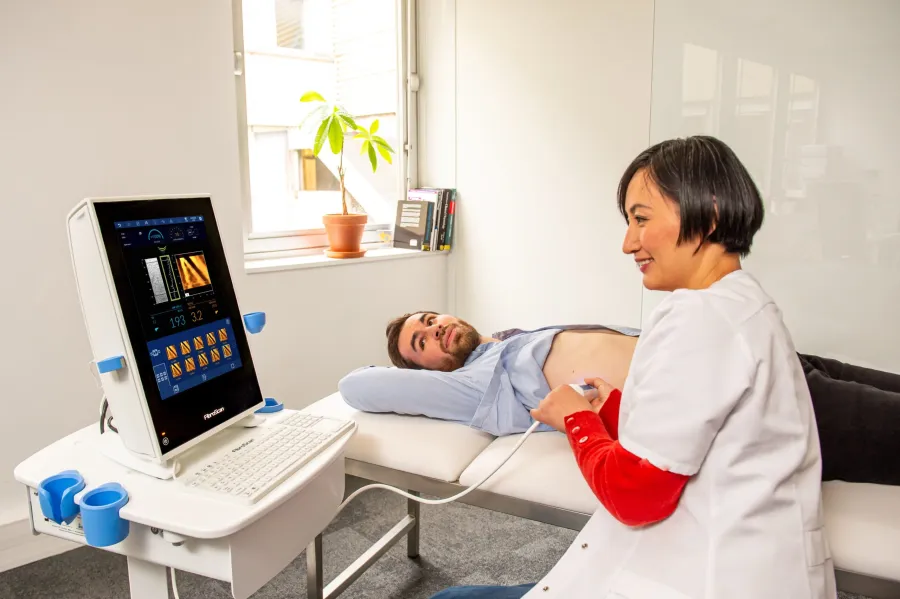
FibroScan is a widely used, non-invasive test that helps assess liver health without the need for needles or procedures. It has become an important part of modern liver assessment and is now commonly used to evaluate conditions such as fatty liver disease, alcohol-related liver disease, and chronic viral hepatitis.
For many patients, FibroScan provides clarity and reassurance. For others, it helps identify liver scarring at an early stage, when action can still make a real difference.
What is a FibroScan?
FibroScan is a specialised ultrasound-based test that measures ‘how stiff the liver is’. Liver stiffness is important because it increases as scar tissue (fibrosis) develops.
The test also provides information about the amount of fat in the liver, which is particularly useful in people with suspected fatty liver disease.
Importantly, FibroScan does not involve needles, injections, or sedation, and usually takes only a few minutes. Patients usually get their result and interpretation of the findings at the same appointment.
Why is liver stiffness important?
When the liver is exposed to long-term stress or damage — such as from excess fat, alcohol, or inflammation — scar tissue can gradually form. This process is known as fibrosis (scarring).
Early fibrosis may cause no symptoms and may not show up on routine blood tests. Over time, fibrosis can progress to cirrhosis, which carries a higher risk of complications, including liver cancer.
FibroScan helps estimate how much scarring is present, allowing clinicians to:
- Identify liver disease earlier
- Monitor progression or improvement over time
- Decide who needs closer follow-up or treatment
What happens during the test?
During a FibroScan:
- You lie on your back with your right arm raised
- A small probe is placed on the skin over the liver
- Gentle vibrations are sent through the liver tissue
- Measurements are taken within a few minutes
The test is painless and most people describe it as feeling similar to a standard ultrasound scan.
Who should consider a FibroScan?
FibroScan is commonly used in people who:
- Have known fatty liver disease or risk factors such as diabetes or obesity
- Have been found to have fatty liver on an ultrasound scan
- Have persistently abnormal liver blood tests
- Drink alcohol regularly and want an assessment of liver health
- Have chronic viral hepatitis or any chronic liver condition
It is particularly helpful when liver blood tests are normal but risk factors for liver disease are present.
What FibroScan can and cannot tell us
FibroScan is very good at estimating liver fat and scarring, but it does not provide information about every aspect of liver disease.
FibroScan can:
- Estimate the degree of liver scarring and fat
- Help identify people at low vs higher risk of liver disease
- Can be repeated safely to monitor change over time
It does not:
- Replace clinical assessment
- Identify the exact cause of liver disease on its own
- Completely replace liver biopsy in more complex cases
Results should always be interpreted alongside blood tests, imaging, and clinical history.
Why FibroScan has changed liver care
In the past, assessing liver scarring often required a liver biopsy. FibroScan has transformed liver care by allowing:
- Earlier detection of liver damage
- Safer, repeatable monitoring
- Reassurance for patients with low-risk findings
For many people, it removes uncertainty and helps guide clear next steps.
Key message
FibroScan is a simple, safe, and effective way to assess liver health. When used as part of a comprehensive liver assessment, it helps identify liver scarring early, guide management, and provide reassurance, where appropriate.